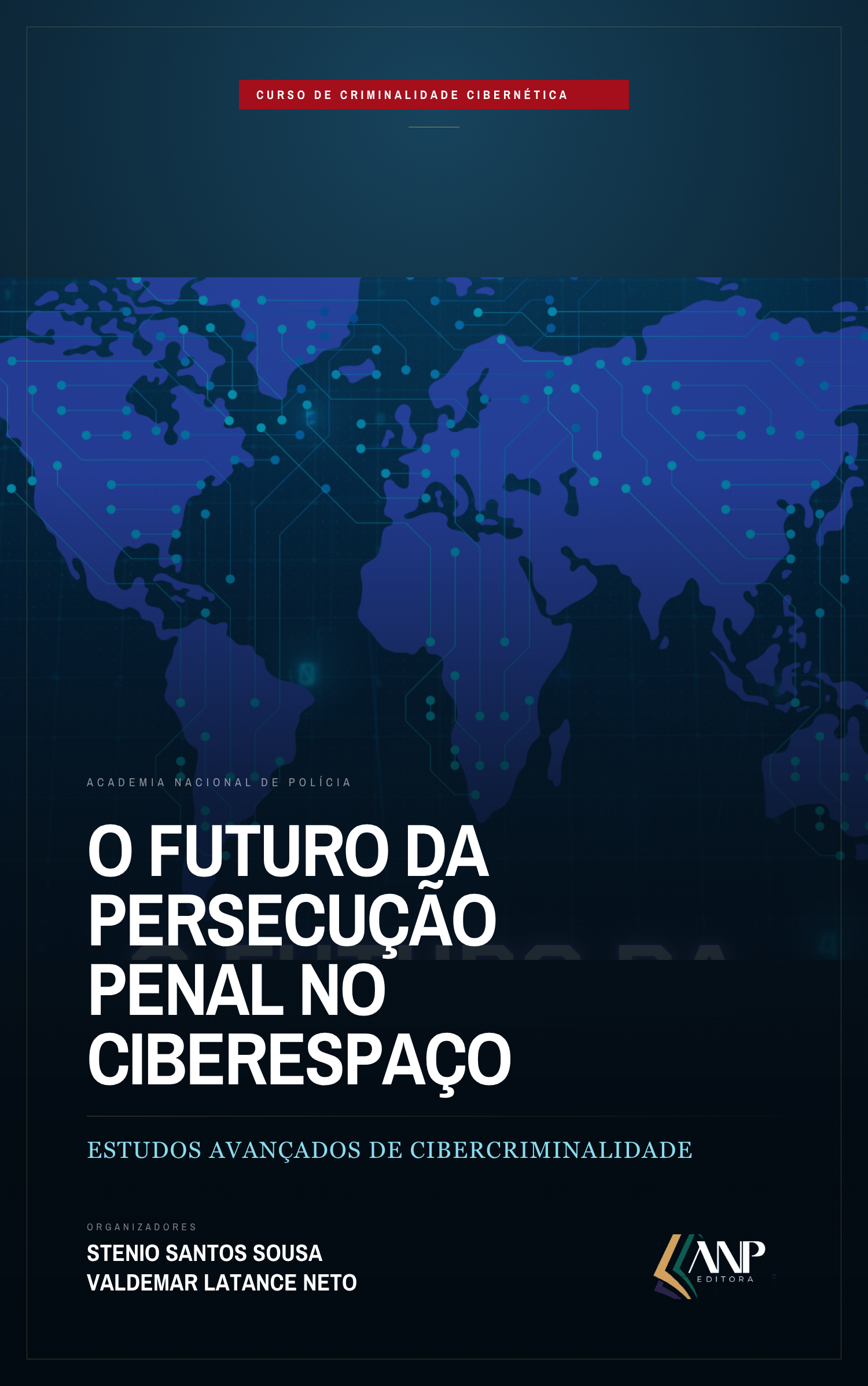
O Futuro da Persecução Penal no Ciberespaço
English title: The Future of Criminal Prosecution in Cyberspace
Advanced Studies in Cybercrime
Synopsis
Cyberspace is no longer a marginal or merely instrumental space; it has become a central dimension of contemporary crime, affecting the definition of legally protected interests, the shaping of criminal offenses, the methods of criminal investigation and the very foundations of due process of law. The book starts from the premise that tackling crime in cyberspace cannot be understood merely as a technological issue, but as a complex legal and criminal phenomenon that requires an integrated reading of Criminal Law, Criminal Procedure, Criminology, Criminal Policy and Computer Science. The result is a cohesive work that reflects the commitment of the National Police Academy (ANP) to producing applied, critical knowledge aligned with the real challenges of public security in a network society.
Foreword (English translation)›
The growing use of digital technologies as a structuring medium for social, economic and institutional relations has profoundly transformed the criminal phenomenon and, consequently, the traditional models of criminal prosecution.
Cyberspace is no longer a marginal or merely instrumental space; it has become a central dimension of contemporary crime, affecting the definition of legally protected interests, the shaping of criminal offenses, the methods of criminal investigation and the very foundations of due process of law.
Criminal prosecution thus comes to operate in an environment marked by transnationality, by the volatility of digital traces, by the technological asymmetry between offenders and the State, and by the growing incorporation of automated systems and artificial intelligence into the production, analysis and assessment of digital evidence. As Manuel Castells (2010) observes, the network society redefines forms of power, control and conflict, demanding from the Law responses that go beyond normative models conceived for a territorial, linear and materially stable reality.
It is in this context of structural transformation that the book O Futuro da Persecução Penal no Ciberespaço: estudos avançados em cibercriminalidade [The Future of Criminal Prosecution in Cyberspace: Advanced Studies in Cybercrime] is situated, organized from selected works of the 1st Specialization Course in Cybercrime of the National Police Academy (ANP). The collection brings together research that engages directly with contemporary problems faced by criminal prosecution bodies, particularly within the Federal Police, combining academic rigor, critical reflection and professional experience.
The book starts from the premise that tackling crime in cyberspace cannot be understood merely as a technological issue, but as a complex legal and criminal phenomenon that requires an integrated reading of Criminal Law, Criminal Procedure, Criminology, Criminal Policy and Computer Science.
It adopts a perspective close to the idea of a networked Law, as formulated by François Ost and Michel van de Kerchove (2002), in which legal normativity is built from multiple, dynamic and decentralized interactions, in contrast to the classical hierarchical and pyramidal models of the Austrian Normativist School, whose best-known exponent is the author of the “Pure Theory of Law”, Hans Kelsen.
The chapters of the book are arranged to reflect a logical and thematic progression. Part I is devoted to cyber-procedural phenomena related to digital evidence, cyber investigation and fundamental guarantees, covering the chain of custody of digital evidence on mobile phones, the legal and investigative treatment of IP addresses, and the impact of synthetic content generated by artificial intelligence, especially deepfakes, on the reliability of criminal evidence. These topics highlight the need to update classical procedural categories in light of due process of law and the garantist model of Criminal Law (FERRAJOLI, 2002), which is fully applicable to the digital environment.
Part II turns to organized crime in cyberspace, with particular attention to electronic bank fraud, the use of digital financial structures and the activity of criminal networks that use technology to increase their scale, conceal authorship and hinder criminal prosecution. This approach engages with the specialized literature (WALL, 2007; TROPINA, 2012), which points to the growing professionalization and organization of crime in cyberspace, requiring increasingly qualified investigative and intelligence responses.
In Part III, the book addresses the phenomenon of online sexual abuse and exploitation of children and adolescents, covering both the analysis of offenders’ modus operandi in cyberspace and the assessment of technological tools, investigative strategies and preventive approaches aimed at criminal prosecution and the comprehensive protection of children and adolescents. This is a sensitive and strategic thematic axis, which highlights the need to coordinate criminal repression, prevention and public policy.
Part IV is devoted to critical reflection on criminal policy in cyberspace, addressing phenomena such as online hate speech and the limits of criminal intervention in democratic societies. These analyses engage with the contemporary debate on the risks of excessively expansive criminal responses in the digital environment, emphasizing the importance of balancing the effectiveness of criminal prosecution with the protection of fundamental freedoms.
Finally, Part V broadens the traditional field of cybercrime by showing how cyberspace has become a cross-cutting medium for offenses that are not typically digital, such as organized environmental crime. This approach reinforces the understanding that cyberspace is not an isolated domain, but an environment that permeates and amplifies various forms of crime, demanding integrated and interdisciplinary institutional responses in the field of criminal prosecution.
The result is a cohesive work that reflects the commitment of the National Police Academy to producing applied, critical knowledge aligned with the real challenges of public security in a network society.
By bringing together research that moves between academic rigor and professional experience, this collection seeks to contribute to an informed debate on the direction of criminal prosecution in cyberspace. Rather than offering definitive answers, the book aims to foster critical reflection and to point to possible paths for building models of criminal investigation and repression compatible with the legal, technological and institutional challenges of contemporary crime. The book closes with a concluding essay by the editors, which proposes an integrative reading of the chapters based on the emergence of a networked criminal prosecution.
Brasília-DF, 25 September 2026.
Stenio Santos Sousa
Doctoral candidate in Public Legal Sciences (University of Minho, Portugal); Master in Police Sciences, Criminology and Criminal Investigation (ISCPSI, Portugal) and in Law (UnB); Scientific Coordinator and Lecturer of the Postgraduate Program in Cybercrime of the National Police Academy (ANP-PF)
Valdemar Latance Neto
Specialist in Police Intelligence (ANP-PF); General Coordinator for Combating Cybercrime and Lecturer of the Postgraduate Program in Cybercrime of the National Police Academy (ANP-PF)
Topics & Keywords
Structure & Contents
English translation of the original Portuguese headings.
- ›Part I: Digital Evidence, Cyber Investigation and Fundamental Guarantees
- ›Ch. 1: The chain of custody of digital evidence in the handling of mobile phones: legal and operational challenges in executing search and seizure warrants (Bruno Santos Campos)
- ›Ch. 2: Privacy and investigation: the IP address as subscriber data in Brazilian law (Renzo Ramos da Gama)
- ›Ch. 3: Deepfakes, artificial intelligence and the reliability crisis of digital evidence: technological risks and impacts on criminal prosecution (Lorena Pereira Campos de Oliveira)
- ›Part II: Organized Crime in Cyberspace and Digital Fraud
- ›Ch. 4: Electronic bank fraud and organized crime in cyberspace: the migration of criminal organizations to cybercrime and police intelligence as an essential instrument for qualified repression (Marcelo Ribeiro da Silva Júnior)
- ›Ch. 5: Money mule accounts and fraud in the digital banking system: limits of the reactive model and challenges for effective criminal prosecution (Rafael Gomes Cirino)
- ›Part III: Online Sexual Abuse of Children and Adolescents: Investigation and Prevention
- ›Ch. 6: Grooming strategies in cyberspace: an analysis of the modus operandi of sexual predators in the digital environment (Keyla Nunes da Silva Lima)
- ›Ch. 7: Institutional tools and criminal prosecution in tackling online sexual abuse of children and adolescents: potential and limitations of Comunica PF (Natália Ribeiro da Silva)
- ›Ch. 8: Methodologies for preventing sexual violence against children and adolescents in digital environments: an integrative literature review and implications for protection policies and criminal prosecution (Ivan de Sousa Ricardo)
- ›Part IV: Criminal Policy in Cyberspace and Hate Speech
- ›Ch. 9: An analysis of the progression of misogynistic discourse in the virtual environment (Flávio Rolim Pinheiro Resende)
- ›Part V: Cyberspace, Environmental Crime and the Expansion of Criminal Prosecution
- ›Ch. 10: Challenges for the Federal Police in repressing the cyber trafficking of wild animals (Joziel Brito de Barros)
- ›Concluding essay: Criminal prosecution in cyberspace and the emergence of a Networked Criminal Law (Stenio Santos Sousa and Valdemar Latance Neto)
Product Details & Bibliographic Data
How to Cite this Work
SOUSA, S.; LATANCE NETO, V.; CAMPOS, B. S.; GAMA, R. R. da; OLIVEIRA, L. P. C. de; SILVA JÚNIOR, M. R. da; CIRINO, R. G.; LIMA, K. N. da S.; SILVA, N. R. da; RICARDO, I. de S.; RESENDE, F. R. P.; BARROS, J. B. de. O futuro da persecução penal no ciberespaço: estudos avançados de cibercriminalidade. 1. ed. Brasília: ANP Editora, 2026. 365 p. ISBN: 978-65-996797-3-5. DOI: https://doi.org/10.5281/zenodo.22982957.
@book{sousa2026persecucao,
  title={O futuro da persecu{\c{c}}{\~a}o penal no ciberespa{\c{c}}o: estudos avan{\c{c}}ados de cibercriminalidade},
  author={Sousa, S. and Latance Neto, V. and Campos, B. S. and Gama, R. R. da and Oliveira, L. P. C. de and Silva J{\'u}nior, M. R. da and Cirino, R. G. and Lima, K. N. da S. and Silva, N. R. da and Ricardo, I. de S. and Resende, F. R. P. and Barros, J. B. de},
  year={2026},
  edition={1},
  publisher={ANP Editora},
  address={Bras{\'i}lia},
  isbn={978-65-996797-3-5},
  doi={10.5281/zenodo.22982957},
  pages={365}
}